
Home › What We Do › Websites
Websites that close
The click is the easy part. The call is the point.
Everything else we run has one job: send the right person to your website. What happens in the next few seconds decides whether that spend turned into a customer or into nothing. So we build the site to hold up under that pressure. Fast on a phone, obvious to act on, and structured so search engines and AI answer engines can actually read what you do.
Free, no obligation, and genuinely useful even if we never work together.
The expensive mistake
Good traffic sent to a weak site is money you already spent.
Ads, the magazine, your listing, a neighbor’s recommendation. Every one of those costs you something, and every one of them ends at the same place. If that page is slow to open on a phone, or makes a ready-to-buy homeowner hunt for the phone number, you paid full price for a visit that goes nowhere. It’s the quietest way a local marketing budget disappears, because nothing looks broken. The traffic reports even look healthy.
Most local business sites are template builds. They were cheap or free to start, they load a pile of code the business never asked for, and they were laid out to look like a brochure instead of to get someone on the phone. That was survivable when people compared three companies in a phone book. It isn’t survivable when the comparison happens in a few impatient seconds on a phone, in a driveway, with two competitors open in other tabs.
This is also why we’d rather fix the site before we scale the spend. Turning up the volume on a leaky funnel just makes the leak more expensive.

What that usually looks like
- A slow first load on a phone, which is exactly where a ready buyer has the least patience.
- The phone number buried in a footer, in small grey text, that doesn’t dial when tapped.
- Copy that never says plainly what you sell or which towns you serve, so nothing can categorize you.
- Hours, services, and offers that went stale two seasons ago because updating it is a hassle.
What we build
Fast, mobile-first, and built to get you called.
Not a brochure with your logo on it. A working piece of the growth system, built on AWS, aimed at one outcome: the person who landed here picks up the phone.

Fast, on a phone, first
Built lean and designed for the small screen before the large one, with Core Web Vitals in mind. The version most of your customers see is the version we optimize hardest.
Click-to-call everywhere
A tappable phone number in the header, a sticky call bar on mobile, and one obvious primary action on every screen. Nobody should ever have to look for how to reach you.
AI-ready, so machines can read you
Clear structure, real local content, technical SEO, and GEO foundations, so an answer engine can tell what you sell and where you serve. An assistant can’t recommend a business it can’t understand.
Built to be found
Local SEO foundations, real pages for the services you sell and the towns you serve, and information that matches your listings exactly. Updates handled for you, so it stays current.
We build to support stronger search and AI visibility. We do not promise guaranteed rankings, guaranteed leads, or guaranteed placement in ChatGPT or Google AI. Anyone who says otherwise is selling you something.
The standard
What a website actually has to do.
Strip away the taste and the trends and there are four jobs. A site that does all four earns its keep. A site that misses one quietly wastes whatever you spend to fill it.
Owner to owner. I’ll tell you on the call if your site is already fine.
Open before they give up
On a phone, on a weak signal, in a driveway or a parking lot. Speed isn’t a technical detail here. It’s the first thing a stranger learns about how you run your business.
Make the next step impossible to miss
One primary action, repeated, always in reach. Call, book, or request the estimate. When a visitor has to decide what to do next, most of them decide to leave.
Answer the question a machine is asking
What you sell, where you serve, who you are, and why you can be trusted, written plainly and structured so Google and the AI answer engines can lift it. Often the first pitch is made by software, before you ever get the call.
Stay true after launch
Hours, services, seasonal offers, and new proof kept current, because a wrong detail costs you the call just as surely as a slow page does. We handle the updates so it doesn’t become one more thing on your list.
One connected system
The traffic has to land somewhere that converts.
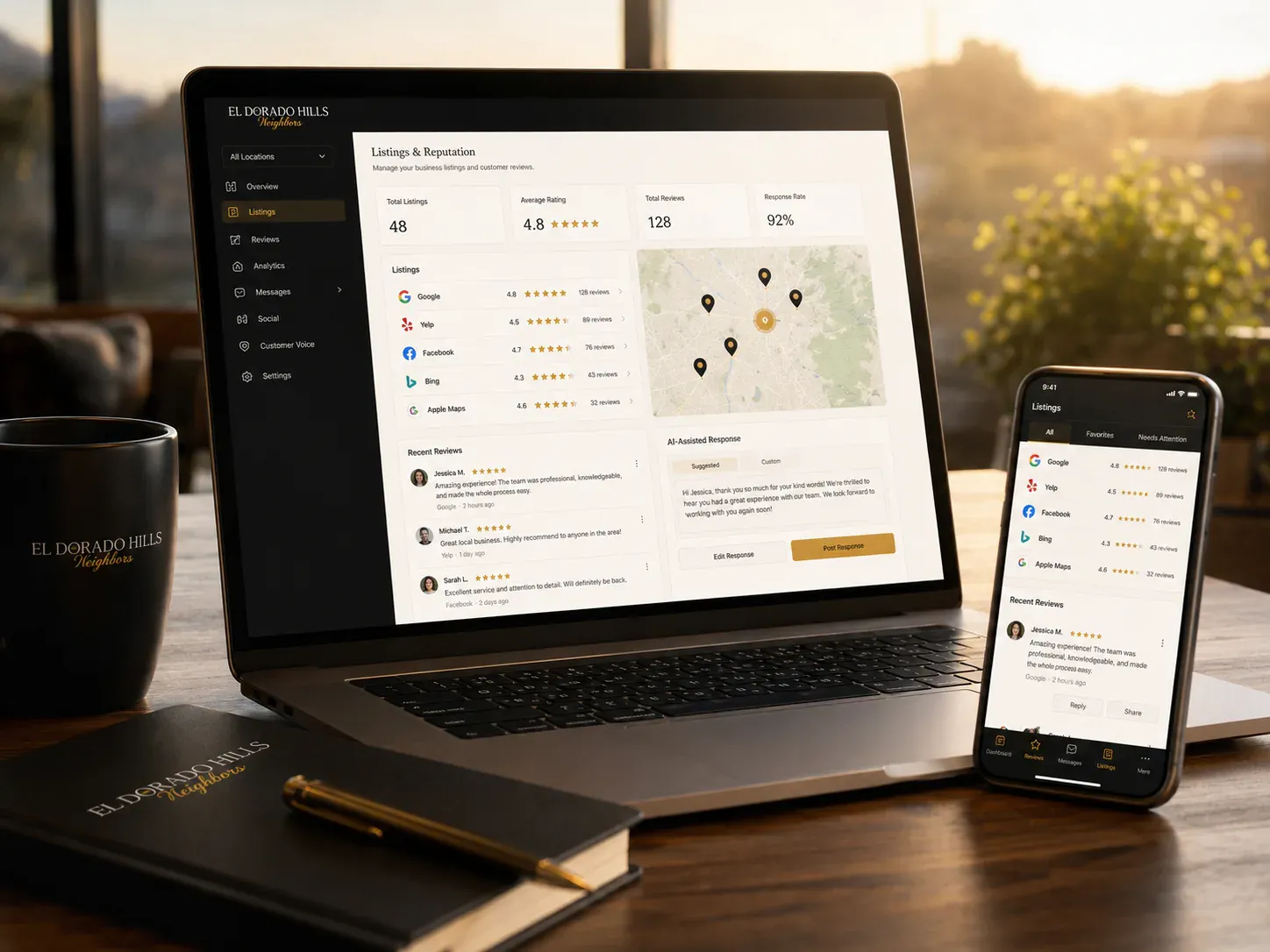
This is why we’d rather run the whole system than sell you one piece of it. Geo-targeted digital delivers 30,000 to 280,000 monthly impressions depending on the package, and reaches up to 100,000 or more local household decision-makers a month on the larger ones. The magazine reaches 5,400 or more affluent El Dorado Hills households and stays in the home for a month. Your listings catch the people already searching for what you sell.
All of it points at one destination. When the ad, the printed page, the map pin, and the website say the same thing in the same voice, the household that keeps seeing you arrives already half convinced. When they say different things, you paid for the impression and lost the sale on arrival.
Reach figures describe package delivery and audience size. Partner performance figures are read from each partner’s own reporting dashboard over a 90 day period and measure visibility, not guaranteed results.
How the pieces hand off
- Digital ads point at the page built for that offer, not at a generic home page.
- The magazine ad and the site carry the same promise, so recognition isn’t wasted on a mismatch.
- Your name, address, hours, and services agree across the site, your listings, and your map pin.
- Retargeting follows the visitors who left without calling, so one visit isn’t your only shot.
- We review the whole thing together, in plain English, instead of mailing you a login.
Real owner, real review
What the process is like to be on the other side of.
“I highly recommend Clinton. The dedication, personal thoughtfulness, attention to detail, and the overall quality of his work, is unmatched. Clinton is very communicative, patient, and supportive through every step of the process. Clinton truly cares about bringing vision to life and ensuring a professional final product.”
Quoted exactly as written on our Google Business Profile, which you can open and read yourself. No performance figures are attached to this review, because we only publish numbers we can point to on a partner’s own dashboard.
Straight answers
The questions worth asking before you hire anyone.
Do I own the website?
Ask that question of anyone who builds you a site, and ask it before you sign. Ownership, hosting, and your domain are written into your agreement in plain language, and I walk you through all three on the call rather than leaving them in fine print. Your content, your photos, your Google Business Profile, and your reviews are yours the whole way through. Those were never mine to hold.
What happens if I leave?
You should know the answer before you start, not after. What happens to the site, the domain, and your content if you stop is spelled out in the same agreement, and we go through it together up front. Your Google Business Profile, your reviews, and your customer relationships stay with you regardless. If I ever have to keep a client by making it painful to leave, I’ve already lost the argument.
What makes a website AI-ready, and why does it matter?
An AI-ready website is built with clear structure, strong local content, technical SEO, and GEO foundations, so both customers and AI-powered search tools can understand who you are, what you do, and where you serve. Ours are built on AWS. When someone asks an assistant instead of scrolling a results page, that assistant can only recommend a business whose site it can actually read. We build to support that visibility. We do not promise a specific placement in ChatGPT or Google AI.
My site is only a couple of years old. Do I really need a new one?
Maybe not, and I’ll tell you so. Bring it to the call and we’ll look at three things together: how fast it loads on a phone, how many taps it takes to call you from it, and whether a search engine or an answer engine can tell what you sell and where you serve. If it’s already doing those three things, keep it and put the money into reach instead.
What does a website cost, and how long does it take?
Every plan is built to fit your category and your goals, so the honest answer is that we scope it on a call. Across the whole system, placements start at $360 a month, most partners land between $1,000 and $2,500 a month, and owners after rapid, expansive growth start at $3,000 a month. Bring what you have now and we’ll show you the plan and a realistic timeline. A conversation, not a pitch.
The next step
Let’s look at your site the way a customer does.
Thirty minutes, owner to owner. We open your site on a phone, walk it like a stranger who’s ready to buy, and I tell you plainly what’s costing you calls. You keep everything we find, whether or not you work with me.
Free and no obligation. A local owner picks up.