
Home › The Local Journal › AI is already answering for your business
The Local Journal
AI is already answering for your business. Here’s what it’s saying.
Somebody in El Dorado Hills asked an assistant for a plumber this morning and got three names back. You didn’t get to see the question, and you didn’t get to bid on the answer.
By Clinton Goodrich, owner and publisher. Published July 22, 2026.
A growing share of local searches now end in a generated answer instead of a list of links. ChatGPT, Google’s AI answers, Siri, Copilot and the assistant built into every new phone will name two or three local businesses and move on. There’s no second page. If you aren’t one of the names, you were never in the conversation.
The good news is that these systems aren’t mysterious about what they trust. They’re conservative. They name a business when several independent sources already agree about it, and they skip a business when the sources disagree or there aren’t any. That’s a fixable problem, and it’s cheaper to fix than most owners expect.
Where an AI answer actually comes from
When someone asks for a recommendation in a specific town, the answer gets assembled from four places:
- Map and profile data. Your Google Business Profile, Apple Maps, Bing Places and the directories that feed them. Category, service area, hours, phone, address.
- Your own website, but only the parts a machine can read plainly. What you do, where you do it, and who you are, stated in ordinary sentences rather than implied by a slideshow.
- Reviews. Not just the star rating. The words in them, how recent they are, and whether anybody responds.
- Everyone else’s pages. Mentions of your name somewhere other than your own site. This is the one local businesses have the least of.
Agreement across those four is the whole game. A business whose hours say one thing on Google, another on Yelp and nothing at all on its own site is a business an answer engine has a reason to skip. Not out of malice. Out of caution.
Why it recommends your competitor instead of you
Almost never because they’re better at the work. Usually because they’re easier to confirm. The four most common reasons, in the order I run into them:
- Your information disagrees with itself. An old suite number on one directory, a disconnected number on another, hours that changed two years ago. Every mismatch lowers confidence in all of it.
- Your website never says the plain thing. A beautiful hero image and a tagline that could belong to any industry. If the page never states “we do X in El Dorado Hills, Folsom and Cameron Park,” nothing can quote you saying it.
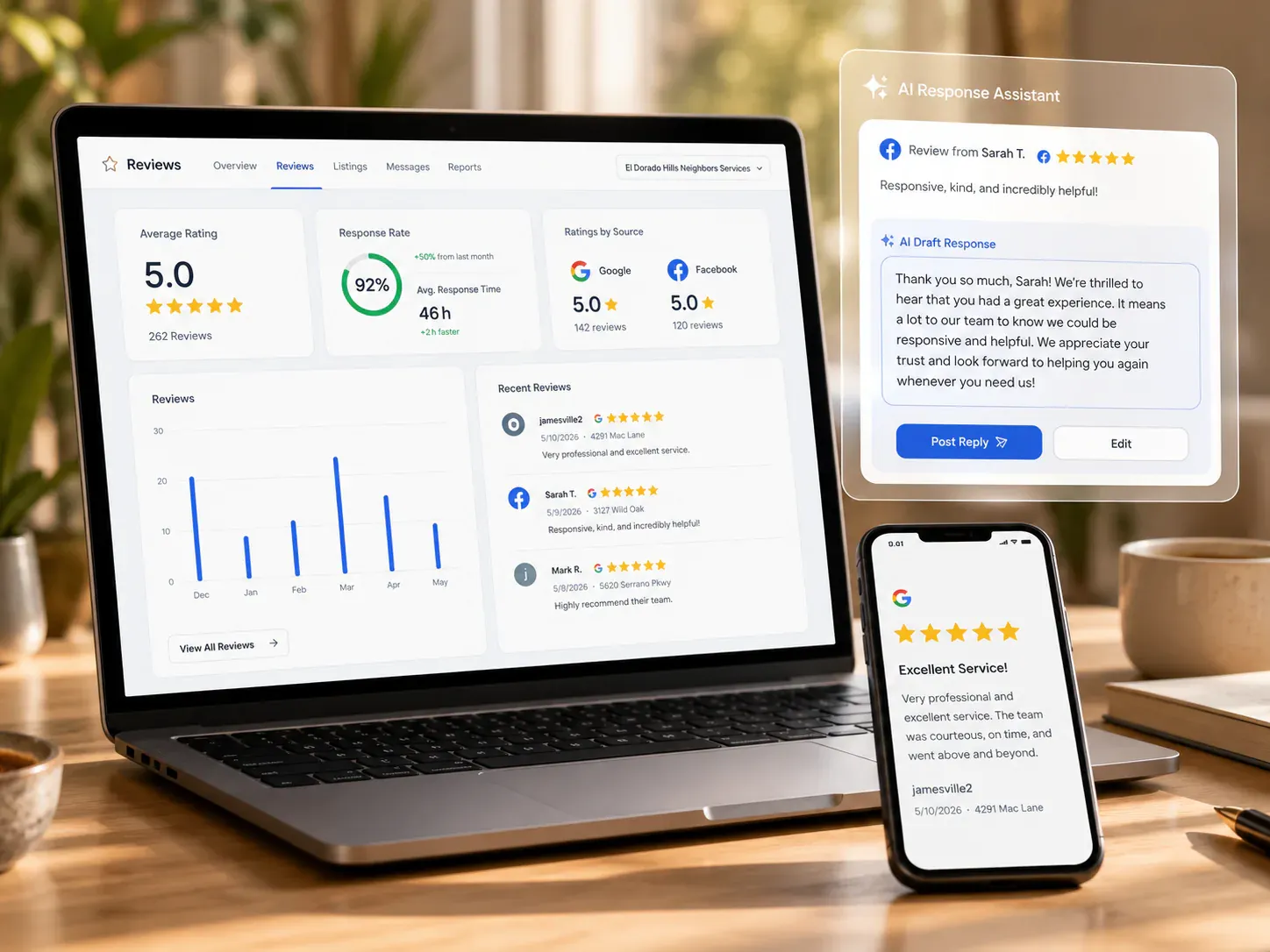
- Your reviews are thin or old. Nineteen reviews, most from 2022, none answered. A competitor with sixty recent ones and replies looks like an operating business by comparison.
- You exist only on your own site. A business that nothing else on the internet has ever mentioned reads as unverified. It’s the difference between a claim and a corroborated claim.
Try it yourself before you do anything else. Open ChatGPT or your phone’s assistant and ask it, exactly the way a customer would: “Who’s a good [your category] in El Dorado Hills?” Ask a few different ways. Whatever comes back is the honest starting point, and it takes five minutes.
The fix
Make yourself easy to verify.
Everything here is unglamorous and most of it is free. That’s exactly why so few local businesses have done it.
Make every listing say the same thing.
Name, address, phone, hours and categories identical across Google, Apple, Bing, Yelp, Facebook and the data aggregators behind them. Identical, not similar. This is the single highest-return hour in local marketing and it’s the one nobody wants to spend.
Say the plain thing on your own site.
A sentence that names your service, your towns and your credentials in ordinary language. Real answers to real questions on the page. If a machine can’t find a clear statement of what you do and where, it can’t repeat one.
Add structured data.
Schema markup is the machine-readable version of your business facts, sitting invisibly in your page code. It’s not a ranking trick, it just removes the guesswork. Most local sites have none of it.
Keep reviews current, and answer them.
Recency matters more than most owners think, and a response signals an active business. Ask every satisfied customer. It’s the closest thing to free advertising that also feeds every system judging you.
Get mentioned somewhere that isn’t yours.
Local publications, community organizations, chambers, suppliers, partner businesses. Independent mentions are what turn a claim into a corroborated fact, and they’re the piece almost no local business is building on purpose.
Check it again in ninety days.
These systems change constantly and none of this is a one-time job. Ask the same questions a quarter later and see whether the answer changed. That’s the only scoreboard there is.
Being straight with you
Nobody can sell you an AI ranking.
There’s no placement to buy inside a generated answer, no auction, and no console where a vendor sets your position. Anyone promising guaranteed AI visibility is promising something they don’t control.
Make your listings consistent everywhere, keep reviews current and answered, put the plain facts and the structured data on your site, and give your name somewhere real to appear besides your own pages.
That you’ll be named by any specific assistant, on any specific query, on any specific day. These systems change weekly and none of us gets a vote.
Every one of these fixes also makes you easier to find and easier to trust for the humans. The AI upside is a bonus on top of work that already pays.
Does the magazine help with any of this?
Not directly, and I’m not going to pretend otherwise. A printed page doesn’t feed an index and no crawler reads a mailbox.
What it does do is upstream of the whole thing. Somebody has to want a recommendation before they ask for one, and somebody has to search your name specifically before a branded search exists. Familiarity is what turns “who’s a good roofer” into “is that roofer from the magazine any good,” and the second question is one you win far more often than the first.
So the honest framing is this: the online work decides whether you’re findable. The familiarity work decides whether anyone goes looking. They’re different jobs and they need each other. That’s the whole argument for running them as one system instead of four vendors, and it’s the same argument I make in Google Maps or a community magazine.
Straight answers
What owners ask about AI search.
How does AI decide which local business to recommend?
Why does AI recommend my competitor instead of me?
Can you pay to appear in AI answers?
Does a community magazine help with AI search?
Is this different from regular local SEO?
Keep reading
More from the Journal.
Ready when you are
Want to know what it says about you?
I’ll run your category through the assistants before we talk and show you exactly what comes back, along with what your listings look like today.
Free and no obligation. A local owner picks up. (530) 306-1881