
Home › The Local Journal › Google Maps or a Community Magazine?
The Local Journal
Google Maps or a Community Magazine? What Each One Really Does.
They get compared constantly, usually because they land on the same line of the same budget. That’s the only thing they have in common.
By Clinton Goodrich, owner of a local marketing and advertising agency in El Dorado Hills. Published July 8, 2026. Updated November 3, 2026.
Google Maps and a community magazine aren’t two versions of the same product. Search and Maps capture demand that already exists: someone in El Dorado Hills whose water heater just failed types “plumber near me” and picks from whatever is in front of them. A community magazine works months earlier. It puts your name inside the house before the pipe bursts, so that when the search finally happens, one of those results isn’t a stranger. Both are worth money. They do different jobs. They only feel like rivals because they compete for the same dollars.
What does Google Maps actually do for a local business?
It answers a question that has already been asked. That’s the whole product, and it’s a good one.
Someone typing “emergency plumber El Dorado Hills” at nine on a Tuesday night isn’t browsing. They have a problem, they have a phone, and they’re going to solve it in the next ten minutes. Nothing else in local marketing puts you in front of a person at that exact moment. If your listing is accurate, your hours are right, your service area is correct and your reviews hold up next to the two names beside you, you have a real shot at that call.
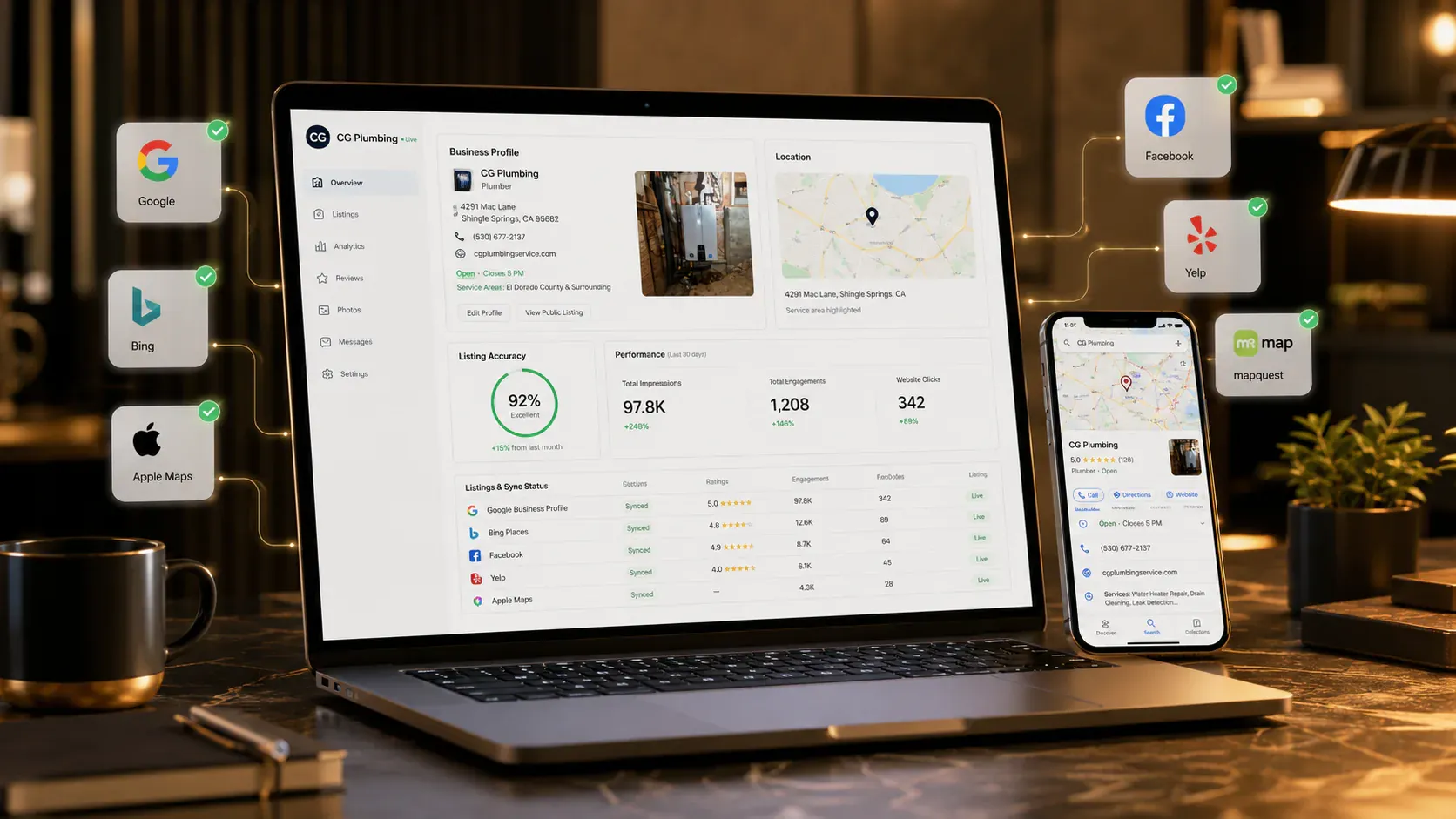
That last part gets skipped a lot. Showing up isn’t the same as getting picked. Ranking in the map pack only gets you into the comparison. What decides the comparison is whether your information is right everywhere someone checks and whether your reviews look like a business people are happy with. That’s the job our listings and reviews work handles, and it’s the cheapest fix most owners are still ignoring.
So why doesn’t search alone solve everything?
Two honest reasons.
First, it’s a bidding war. Every plumber, dentist, roofer and lender in this corridor has figured out the same thing you have, and there are only a few positions worth having. The price of that position isn’t set by what it’s worth to you. It’s set by whoever wants it most this month. You’re renting, not owning, and the rent goes up when a competitor with deeper pockets decides El Dorado Hills is worth taking.
Second, and this is the bigger one: search is completely invisible until intent exists. Nobody searches for a landscaper the month before they decide they want a new yard. Nobody searches for a mortgage broker the year before they think about moving. Search can only catch the fish that swim past. It can’t make more of them swim past, and it has no opinion about which name you already trusted when you typed the query.
We don’t run search ads ourselves. Our Google and Bing campaigns are display ads, and our search work is your listings, reviews, SEO and GEO.
What does a community magazine do that search can’t?
It builds familiarity before the need shows up.
El Dorado Hills Neighbors is mailed to more than 5,400 affluent El Dorado Hills households every month, and 89.4% or more of them read it. It doesn’t get read because of the ads. It gets read because it’s about the people receiving it. Their kids’ teams, their neighbors, the schools and non-profits they support, and a lot of it written by them. So it doesn’t get thrown out. It sits on the counter for the better part of a month.
Your name being in that, month after month, does something an ad can’t do on its own. By the ninth issue you aren’t an advertiser to those households. You’re a name that belongs here, the same way the orthodontist on Francisco or the guy who did their neighbor’s patio belongs here. That’s the entire point of the magazine. It’s not a lead machine. It’s the reason a stranger becomes the obvious choice later.

Where print is honestly weak
I’d rather say this plainly than have you find out in month four.
Print is slow. Familiarity is built over many issues, so a few months is a short test, and the first month is the least valuable one you’ll ever buy.
Print also has no clean performance metric, and we don’t pretend otherwise. There’s no click on a printed page. I can tell you how many households it went to and how many of them read the publication, but I can’t hand you a cost per lead for print, and you should be suspicious of anybody in this business who says they can.
And print is the wrong tool if you need the phone to ring this week. If you’re staring at an empty schedule for the next fifteen days, a magazine that mails in three weeks doesn’t solve that, and display and Meta ads build familiarity rather than catch a live need. Clean listings and recent reviews are where I’d start. That’s not a knock on either one, it’s just a different timeline.
Side by side
Two tools. Two different jobs.
Same budget line, almost nothing else in common.
| The question | Search & Google Maps | The community magazine |
|---|---|---|
| What it’s for | Catching demand that already exists | Creating familiarity before the demand exists |
| Who it reaches | People already typing your category into a phone | 5,400+ affluent El Dorado Hills households, whether they need you yet or not |
| When it works | The minute something breaks or a decision gets made | Months earlier, and again in the month it finally matters |
| How fast | Fast. Days to weeks. | Slow. Think seasons, not weeks. |
| How you measure it | Clicks, calls, direction requests, form fills | Households mailed and readership. No click-level metric, and we say so. |
| Biggest weakness | Invisible until intent exists, and the position is priced by whoever wants it most | Slow to start, and no good answer if you need the phone ringing this week |
| What happens if you stop | The placement stops with the budget | The issues you’re already in stay in the house, but you drop out of the rotation |
| Where the cost comes from | The auction, plus the work of keeping listings and reviews right | A fixed monthly placement. Most partners invest $1,000 to $2,500 a month. The entry point is $540: an eighth-page ad plus Google and Bing display ads and Facebook and Instagram ads. |
Scroll the table sideways to see all three columns.
Readership and household figures are for El Dorado Hills Neighbors. Print has no click-level performance metric, so nothing in this table should be read as a cost per lead.
Why do the two work better together?
Because one of them creates the search and the other one catches it.
Here’s what actually happens with a magazine reader. They see your name for months. They don’t call. Then their neighbor mentions needing the same thing you do, or their own system finally goes out, and what they do next isn’t dial the number in the ad. They google your name. If your listing is stale, your address is old, or you have six reviews and the guy next to you has two hundred, every dollar of that familiarity evaporates in the last inch.
Run it the other way and it’s just as lopsided. If search is all you have, you’re paying full retail for every single customer, because none of them arrived already knowing who you are. You win them on price or on position, and both of those are rented.
That’s why most of our partners run more than one channel. Print and geo-targeted digital put you in front of the same households in the home and in the feed, and listings and reviews make sure you close it when they finally look you up. Most partners land between $1,000 and $2,500 a month running those together. The entry point is $540 a month, which pairs an eighth-page magazine ad with Google and Bing display ads and Facebook and Instagram ads across El Dorado Hills.
For context, over one 90 day window Green Hills Landscaping’s ads delivered 32,465 impressions reaching 28,012 homeowners, and CG Plumbing’s managed listings drew 97,398 views and 1,202 engagements. Those come from each partner’s own reporting dashboard. They measure visibility, not guaranteed results, and there is no equivalent number for print. You can see the rest of them on the results page.
Which one should you start with?
Depends on which problem you actually have.
If you need work booked in the next thirty days, start where intent already exists: get the listings clean and get the reviews moving. Geo-targeted digital then keeps your name in front of homeowners in the service areas you request, but it builds familiarity rather than catching a live need.
If your real problem is that nobody in El Dorado Hills knows your name yet, and you keep losing bids to a competitor who isn’t better than you but is somehow always the one people thought of first, that’s a familiarity problem. Search won’t fix it. Start print now, because the version of you that wins next spring is built this fall.
One more thing worth knowing before you decide. Each category holds one Expert Contributor in each market, a paid position with category exclusivity in the markets the partner selects. In El Dorado Hills that seat is taken right now in dental, landscaping, medical aesthetics, elder care, mental health and counseling, HR staffing and recruiting, and health and wellness practice, and plumbing is full. Real Estate, Mortgage and Lending, and Insurance are open. If you want to know what’s open in yours, or what your market looks like beyond El Dorado Hills, the markets page lays out where we publish and where digital reaches.
The next step
Let’s figure out which one you need.
Owner to owner. We’ll look at what you’re already running, what’s open in your category, and the right way in for your business. If we’re not the right fit, I’ll tell you that too.
Free and no obligation. A local owner picks up.